
Perspective
The Hidden Human Debt of Transformation
Enterprise transformation can alter technology, processes and structures faster than people, leadership practices and organisational conditions can adapt. The resulting gap may quietly erode the value transformation was intended to create.
8 min readDevelopment, Application & Evidence

Most organisations have become remarkably good at changing the enterprise around people. New technology can be deployed, processes redesigned, roles redefined and operating models restructured within increasingly compressed timelines.
Changing how people operate inside that enterprise is different.
A manager does not exercise better judgment because decision rights have been rewritten. A senior leader does not become comfortable with distributed authority because a new operating model calls for it. A team does not become genuinely cross-functional because reporting lines have changed. And an experienced professional does not automatically redefine where they create value because AI can now perform part of the work that once defined their expertise.
The organisation can change before its behaviour does.
At DhruvaLabs, we use the term Human Adaptation Debt for the resulting gap. Not as a formal diagnostic construct, but as a practical leadership lens: the organisational friction that accumulates when the demands of transformation move faster than people, leadership practices and organisational conditions can adapt to them.
The important part here is not people. It is the gap.
Transformation Creates Two Kinds of Change
Most major transformations are changing two systems simultaneously.
The first is structural. Technology, processes, workflows, data, organisational structures, automation and decision rights change what the enterprise is capable of doing. The second is developmental. People must update how they interpret situations, exercise judgment, collaborate, respond to uncertainty, take accountability and understand their role in the organisation.

Structural change can often be engineered. Developmental change has to be learned. And the two do not necessarily move at the same speed.
The scale of this challenge is significant. The World Economic Forum's Future of Jobs Report 2025 found that employers expect 39% of workers' core skills to change by 2030. Importantly, the skills increasing in relevance are not exclusively technical. Resilience, flexibility, agility, creative thinking and leadership are also becoming more important.
That suggests something larger than a re-skilling problem. Organisations are continually creating new adaptation demands.
The strategic question is whether the human system has sufficient adaptation capacity to absorb them. When adaptation demand repeatedly exceeds adaptation capacity, Human Adaptation Debt begins to accumulate.
The Problem Is Often Visible. Its Cause Is Not.
Human Adaptation Debt rarely appears as a line item on a transformation dashboard. It tends to appear through contradictions.
A company deploys AI but retains the same decision habits. It creates cross-functional teams while continuing to reward functional optimisation. Managers are given greater accountability, but consequential decisions still travel upwards. Experimentation becomes part of the strategy, while unsuccessful experiments continue to carry disproportionate career consequences. People are re-skilled for new roles without being helped to reconsider the professional identities attached to their old ones.
On paper, the organisation has transformed. In behaviour, parts of the previous organisation may still be running underneath it. This is where leaders need to be careful about interpreting what they see.
Not every adoption problem is resistance. Not every execution problem is a capability deficit. People can be behaving perfectly rationally within a system that is giving them contradictory information.
Tell a manager to take ownership, then intervene whenever a decision becomes uncomfortable and the organisation learns something about ownership. Encourage teams to challenge assumptions but reward those who create the least visible disruption, and the organisation learns something about dissent.
The formal organisation communicates through strategy. The behavioural organisation communicates through consequences.
When the two disagree, behaviour usually follows the latter.
Organisations Also Have a Finite Capacity for Change
There is another dimension that transformation programmes can underestimate: people are rarely adapting to one change at a time.
Consider a middle manager who is simultaneously expected to adopt a new AI-enabled workflow, implement a restructuring, work with new performance measures, manage cost pressure, redistribute responsibilities across the team and still deliver the current quarter.
Every initiative may be rational independently. The combined adaptation demand may not be.

Middle managers often carry some of the highest adaptation load in the enterprise because they must absorb change from above while creating enough stability below for performance to continue. They are asked to translate strategy, reassure teams, redistribute work, develop people, make new decisions and often implement changes they did not design.
If that layer becomes overloaded, the organisation can misdiagnose the resulting behaviour as poor management rather than excessive or conflicting adaptation demand.
This is why transformation should not only ask, “How much change can we execute?”
It should also ask, “How much change can this organisation meaningfully absorb?”
That is a very different question.
Capability Is Not the Same as Adaptation
Transformation programmes understandably invest in capability. Do we have the right technology? The right skills? The right data? The right operating model? All essential questions. But capability becomes useful only when people can exercise it in context.
Imagine an organisation that has spent 18 months redesigning itself around faster, decentralised decision-making. Management layers have been reduced and decision rights clarified. Yet six months later, managers continue escalating high-stakes decisions.
Senior leaders begin to interpret this as a lack of ownership. Managers, meanwhile, have seen senior executives repeatedly step back into important decisions when the stakes rise. They conclude that autonomy is conditional. Both sides become frustrated.
The structure has decentralised. The behavioural contract has not. That is Human Adaptation Debt.
Solving it does not necessarily require another communication campaign. Managers may need stronger judgment under ambiguity. Leaders may need to develop a different relationship with control. Decision boundaries may require refinement. Incentives may need to change. Teams may need repeated opportunities to practise the new behaviour safely.
The intervention depends on the mechanism producing the gap.
That is why intelligent human development starts with discovery rather than assuming that everyone needs the same programme.
Leadership Sits Upstream
Culture is often treated as an organisational layer. In practice, much of it is continuously produced through ordinary leadership behaviour: what gets questioned, what gets rewarded, what is tolerated, who gets promoted, how disagreements are handled and what leaders themselves do when pressure rises.

Culture is often shaped in the moment someone tells a leader what they did not want to hear.
Repeated often enough, those signals become the organisation's unwritten operating system.
Research offers some support for the importance of that mechanism. McKinsey & Company's capability-building research found that organisations in which senior leaders role-modelled the behaviour changes they were asking employees to make were 5.3 times more likely to report successful transformations. This is survey evidence rather than proof of causation, but the pattern is difficult for leaders to dismiss.
An organisation cannot sustainably create autonomy through leadership organised around control. It cannot encourage experimentation if certainty is expected before action. And it cannot strengthen accountability if difficult decisions habitually move upwards.
In that sense, the developmental capacity of leadership can eventually become a ceiling on the adaptability of the enterprise.
Development Works Differently When It Is Designed for Transfer
There is also reason to move beyond the assumption that human development is inherently vague or difficult to connect with performance.
A leadership training meta-analysis published in the Journal of Applied Psychology, drawing on 335 independent samples, found meaningful effects of leadership training on learning, transfer to the workplace and results. Importantly, effectiveness varied with design. Needs analysis, feedback, practice, multiple delivery methods and appropriately spaced development were among the characteristics associated with stronger outcomes.
The implication is more important than the statistic.
Development creates enterprise value when insight becomes behaviour in the environment where performance happens.
This is also shaping how we think about our work at DhruvaLabs. Assessment can help reveal patterns beneath performance, but insight alone has limited organisational value. The more consequential work is identifying the capabilities a specific context requires, developing them deliberately, supporting their application in real work and examining whether meaningful change follows.
That is subtly different from adding another training programme.
The objective is to develop the human system alongside the enterprise system.
And the ROI question becomes correspondingly more intelligent. Rather than asking for a universal return on “leadership development,” leaders can ask whether the intervention moved the variables their transformation actually depends upon: perhaps decision-cycle time, escalation frequency, managerial behaviour, cross-functional effectiveness, adoption, accountability or another relevant outcome.
The measure should follow the problem.
Adaptability May Become an Enterprise Advantage
As technology becomes increasingly accessible, many capabilities that once differentiated organisations will become easier to acquire. Tools can be purchased, processes benchmarked, expertise augmented and knowledge increasingly generated on demand.
What remains harder to copy is the organisation's ability to continually update itself.
Can leaders revise assumptions that previously made them successful? Can managers exercise judgment when there is no obvious answer? Can established experts redefine their contribution as the boundaries of expertise move? Can teams learn without becoming defensive? Can the organisation stop rewarding behaviours that were useful in yesterday's environment but constraining in tomorrow's?
These can sound like soft questions. Their consequences are not soft. They affect execution, adoption, decision quality, innovation, accountability and ultimately the return on transformation investment. Perhaps the competitive advantage is therefore not simply transformation speed.
It is adaptation capacity.
A Different Conversation for the Leadership Team
Before the next transformation review, I would put four questions beside the usual conversations about milestones, budgets and implementation:
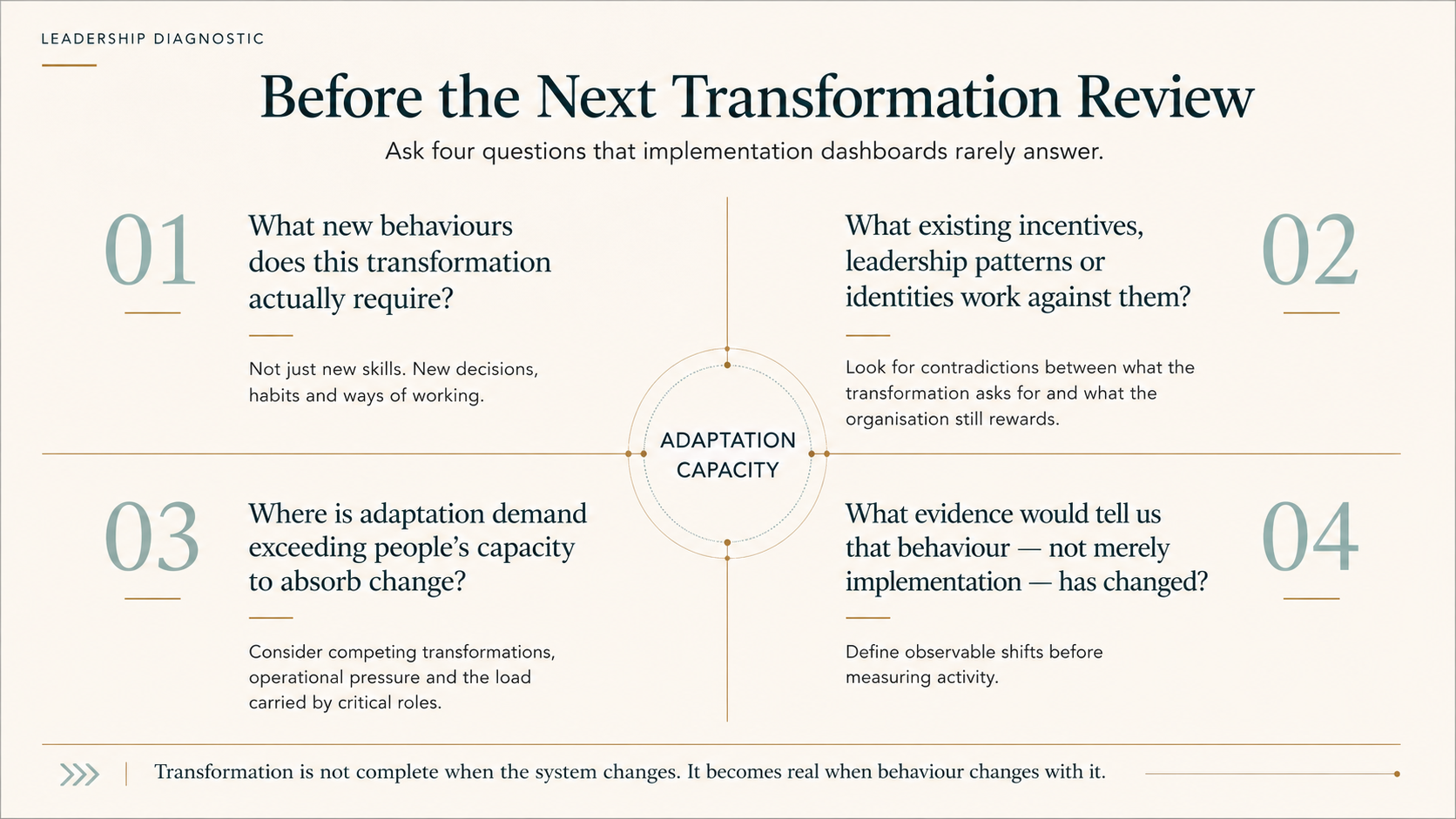
- What new behaviours does this transformation actually require?
- What existing incentives, leadership patterns or professional identities work against them?
- Where is adaptation demand exceeding people's capacity to absorb change?
- What evidence would tell us that behaviour—not merely implementation—has changed?
These questions do not make transformation a “people problem.” Poor strategy remains poor strategy. Bad technology remains bad technology. Conflicting incentives and unclear governance cannot be corrected by asking employees to become more adaptable.
The goal is alignment: between what strategy requires, what the system enables, what leadership reinforces and what people are being asked to become.
When those elements move together, transformation becomes organisational capability. When they move too far apart, debt accumulates. That is the idea behind Human Adaptation Debt.
And it leaves boards, CEOs, CHROs and transformation leaders with a deceptively simple question:
Are We Changing the Organisation Faster Than Its Human System Can Sustainably Adapt?
Because transformation is not complete when the organisation looks different on paper. It becomes real when people can operate differently within it.
Personal evolution is an enterprise variable; but creating the conditions for it is a leadership responsibility.
Sources & Further Reading
- Future of Jobs Report 2025 — World Economic Forum
- Better transformations through capability building — McKinsey & Company. Survey evidence rather than proof of causation.
- Leadership training meta-analysis — Journal of Applied Psychology
From insight to context
Where Is Adaptation Demand Building in Your Organisation?
If transformation is changing what people, managers or teams need to become capable of, Capability Discovery can help distinguish capability gaps from the conditions around them.
Start a Conversation →