
Perspective
AI Is Moving the Bottleneck From Production to Management
Why faster output does not automatically create a faster organisation—and why service firms need to rethink how decisions, accountability and management work.
8 min readChanging Work & Professional ValueCreative, Brand & Marketing Services
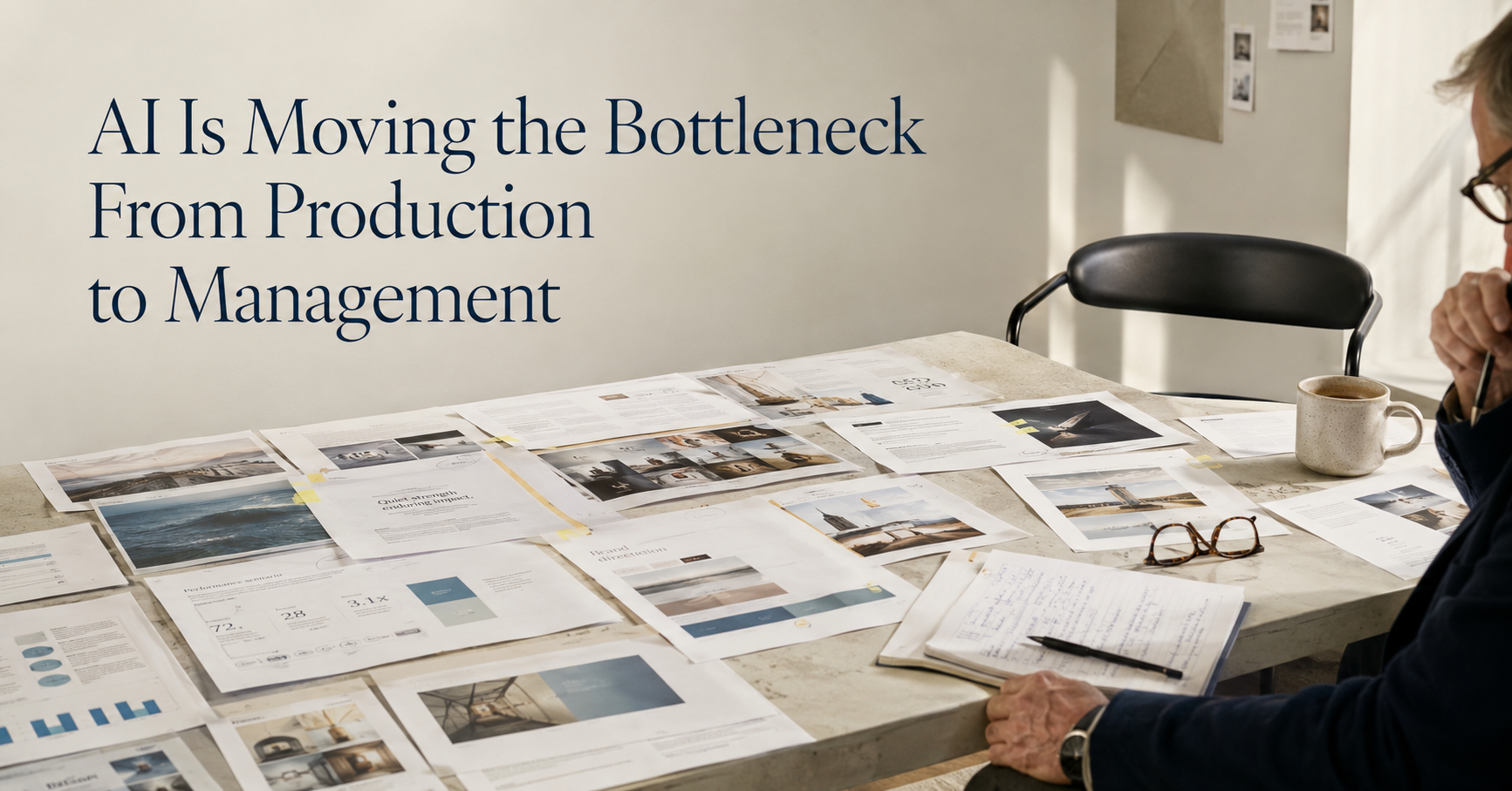
Something important is changing inside marketing, advertising, digital transformation and professional-services firms. The work is getting faster. Research that once took hours can be compressed into minutes. Creative teams can explore more routes earlier. Analysts can evaluate more scenarios. Presentations, prototypes and campaign variations can be produced at a speed that was difficult to imagine a few years ago.
Yet many organisations are discovering an uncomfortable truth: faster work does not automatically create a faster business. The output may be ready, but the decision is not. The analysis may be complete, but approval is still waiting. A team may generate twenty credible possibilities before lunch, but someone still has to determine which two deserve the client's attention.
AI is not necessarily removing the bottleneck. In many service businesses, it is moving the bottleneck from production into management.
When Production Speeds Up, Waiting Becomes Expensive
Most service organisations were designed when high-quality production was relatively expensive. Expertise was scarce. Creative development took time. Research required significant human effort. Multiple reviews helped protect quality. Managers coordinated specialists, checked work, allocated resources and moved deliverables through the system. Much of that made sense for the environment in which those operating practices evolved.
The problem begins when production economics change but the surrounding operating system does not. Imagine an agency team that previously spent two days developing three considered campaign routes. AI-enabled workflows allow the same team to generate twenty plausible starting points in a morning. That is impressive task productivity, but the client has not acquired twenty times more attention. The account lead has not acquired twenty times more decision capacity. And the organisation has not automatically become twenty times better at determining what is strategically distinctive, commercially sensible and worth pursuing.
The scarcity has therefore begun to move from creating possibilities to exercising judgment over possibilities. This is why task productivity and enterprise productivity are not the same thing. A task can become 50% faster without the client receiving the outcome one day sooner. Production time can collapse while the work still travels through the same functional review, account review and senior approval structure.
McKinsey & Company's state of AI research provides a useful signal. Among the organisational attributes it examined, workflow redesign had the strongest relationship with reported EBIT impact from generative-AI use. Yet only around 21% of respondents at organisations using generative AI said their companies had fundamentally redesigned at least some workflows.
The implication is important: new technology operating inside an old workflow may improve local efficiency without producing equivalent enterprise value.
Faster Production Creates Greater Decision Density
There is a second-order effect that deserves more attention from CEOs and COOs. AI does not simply help an organisation produce the same amount of work faster. It enables the organisation to produce more possibilities within the same period of time: more creative concepts, more campaign variants, more strategic scenarios, more analyses, more recommendations and more iterations that a client can reasonably request because the perceived cost of producing them has fallen.
This increases decision density: the number and consequence of judgment calls an organisation must make within a given period. Someone still has to decide what deserves attention, what should be rejected, what is merely plausible versus genuinely good, which client request creates value, which introduces unnecessary complexity, and when an AI-generated answer is sufficient versus when human expertise needs to intervene.
AI can therefore reduce production load while simultaneously increasing selection and judgment load. That distinction matters because uncertainty changes behaviour. When a consequential decision feels risky, asking for another opinion can feel prudent. When client implications are unclear, escalating to a senior leader can feel safer. When responsibility crosses functions, keeping more people involved can appear responsible.
Individually, each behaviour can make sense. Across an organisation, the same behaviours can create collective delay.
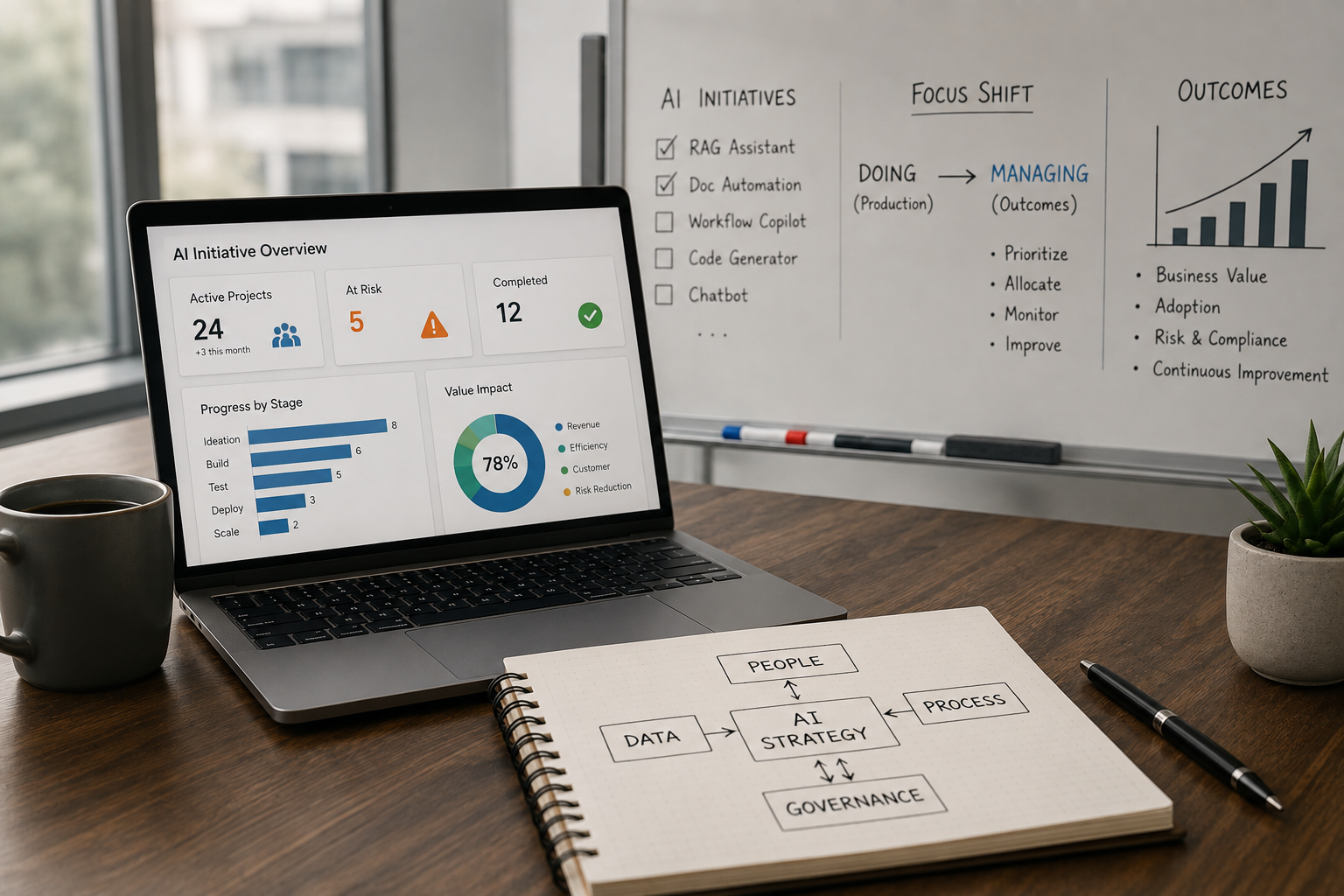
The First Answer Is Cheaper. Trust Is Not.
There is another assumption worth challenging: that faster generation automatically means proportionately less work. In many knowledge-intensive services, AI changes the nature of work rather than simply removing it. Someone still has to determine whether an output is accurate, contextually appropriate, compliant, commercially intelligent and consistent with the client's brand or business problem.
The cost of producing a first answer may fall dramatically. The cost of producing an answer that someone senior is willing to stand behind does not necessarily fall at the same rate.
Recent Harvard Business Review research offers an early illustration. Based on 18 interviews across two major consulting firms, researchers found middle managers taking on additional responsibilities such as validating AI outputs, identifying errors and coaching junior employees in AI use, while continuing to operate under substantial delivery pressure. It is a small qualitative study and should not be generalised to every organisation, but the mechanism is highly relevant to professional services.
This does not necessarily mean less management. It means different management.
The Manager's Job Is Quietly Changing Underneath
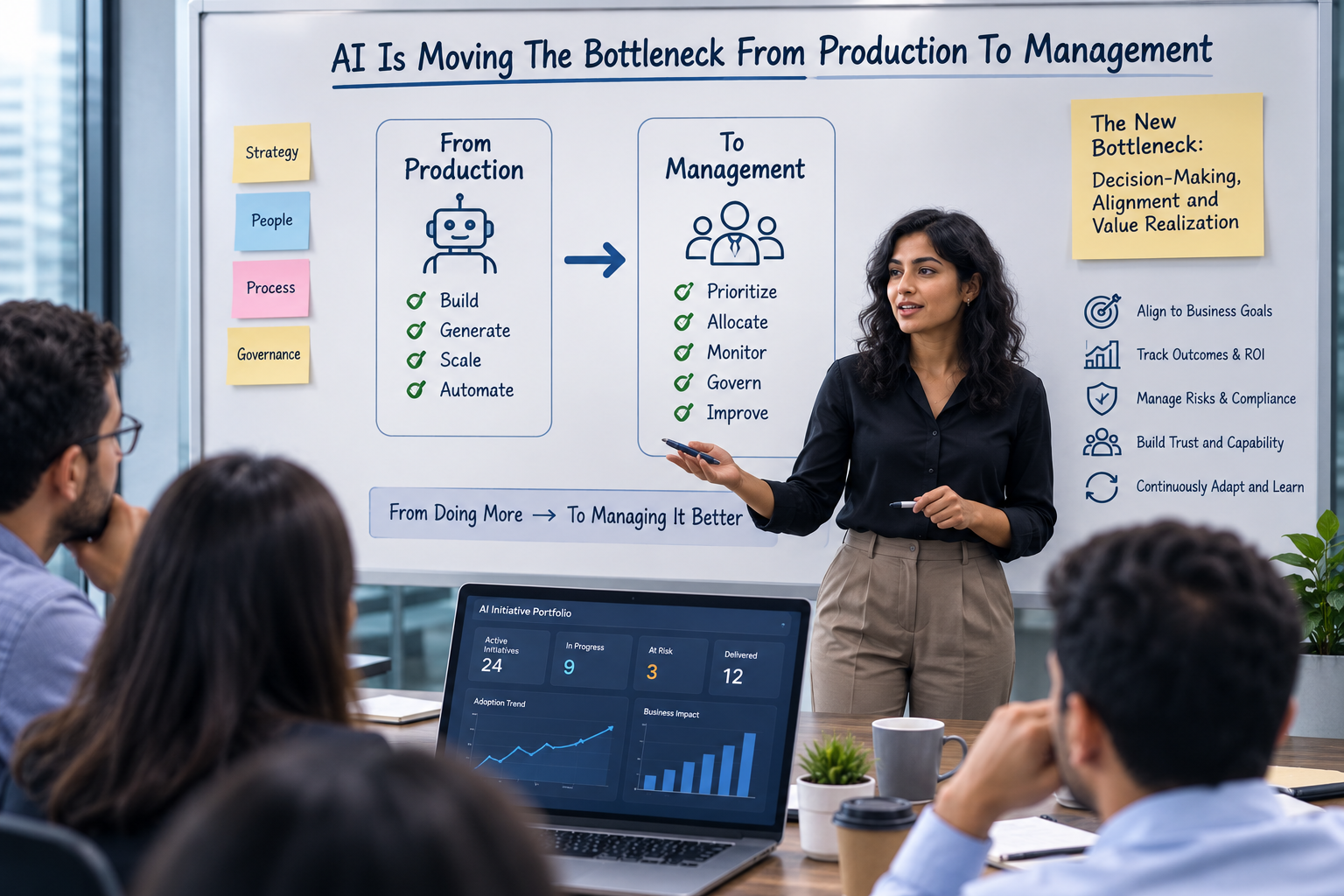
As routine synthesis, first-pass analysis, coordination and portions of quality checking become increasingly augmented, the managerial role becomes disproportionately dependent on capabilities that technology does not automatically provide. Managers need to prioritise when output becomes abundant, distinguish a technically credible answer from a commercially intelligent one, interpret ambiguous client expectations, manage trade-offs across functions, coach people whose roles are changing and challenge weak thinking without recreating unnecessary delay.
The managerial premium therefore begins shifting from coordinating production toward improving the quality and speed of judgment around production.
Yet many service organisations still promote and develop managers largely for the previous job. A strong designer becomes a design manager. A reliable delivery specialist becomes a delivery manager. An excellent marketer becomes a marketing manager. Technical credibility remains important, but excellence as an individual contributor does not automatically create judgment under ambiguity, coaching ability, commercial courage or the capacity to create accountability without excessive control.
The role can evolve faster than the development system supporting it.
But Do Not Mistake a System Issue for a Managerial Issue
This is where discovery needs to become more sophisticated. A highly capable manager can still be trapped inside unclear decision rights, unnecessary approval layers, conflicting KPIs or leadership behaviour that routinely pulls difficult decisions upward. Conversely, an elegant operating model can fail if managers lack the confidence and judgment required to use the autonomy it gives them.
When work accelerates, two different constraints become easier to see. One is structural: how decisions, information, approvals and accountability move through the organisation. The other is human: whether managers can exercise the judgment, confidence and behaviours that the new system demands.
The right executive question is not simply, “Do our managers need training?” It is, “Is the constraint in the system, the manager, or the interaction between the two?”
That distinction matters because each problem requires a different response. Organisations can waste considerable effort trying to solve poor governance with coaching, just as they can redesign processes repeatedly when the real constraint is weak managerial judgment or commercial confidence.
The Client Can Become Part of the Bottleneck Too
Service firms face an additional complication. As production becomes cheaper, client expectations can expand. Requests for more routes, faster turnaround and additional iterations become easier to make when everyone assumes AI has dramatically reduced the effort involved.
Sometimes that assumption is correct. But lower production cost does not make attention, judgment, review capacity or account complexity free. An agency can therefore become faster while simultaneously absorbing more iterations, broader scope and greater decision load. The productivity gain then disappears into the service relationship.
This is why CEOs should be careful about equating more output per employee with better economics. The more useful question is whether faster work becomes greater capacity, stronger margins, better client outcomes or better decisions.
If efficiency is consumed by additional revisions, internal reviews and poorly governed scope, the organisation may become more productive at task level without becoming meaningfully more productive at enterprise level.
The Economics Makes Leadership a Stakeholder
This distinction becomes especially important when organisations evaluate the return on AI adoption. If a team saves four hours creating a deliverable but two of those hours reappear through additional review, unclear ownership or unnecessary iteration, the productivity gain has been diluted. If production becomes cheaper and clients consequently request more variations without clearer commercial boundaries, utilisation may remain high while margins fail to improve. If managers have nominal authority but continue escalating consequential decisions, the organisation may acquire faster technology without achieving meaningfully faster outcomes.
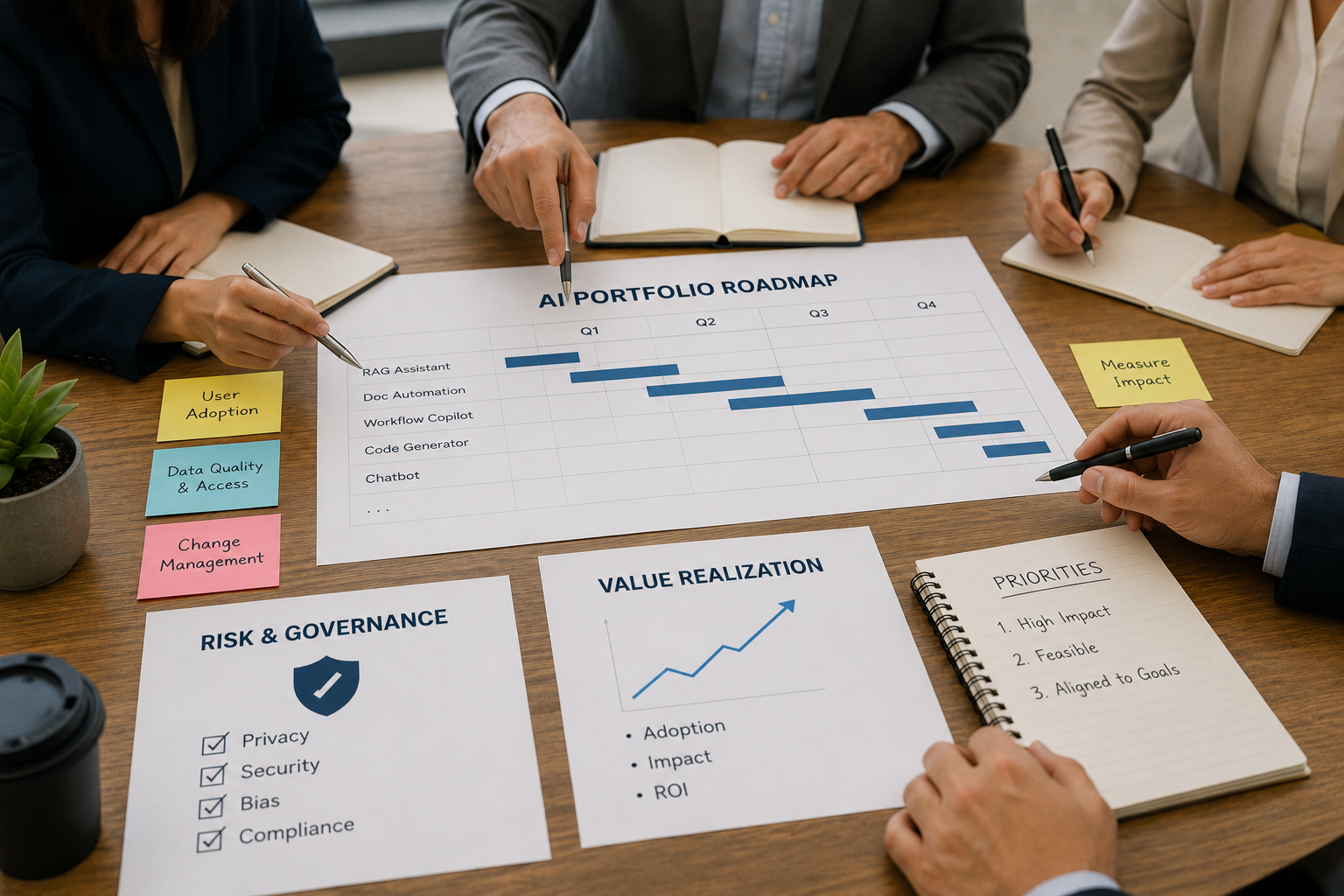
The more useful ROI question is therefore not merely, “How much time did AI save?”
It is:
How much of that saved time became greater capacity, faster client outcomes, better margins or better decisions?
That moves the discussion from tool efficiency to enterprise value.
Discover Before Developing
This also changes the leadership-development conversation. Before prescribing another generic manager programme, organisations need to understand where work is actually slowing. Is authority unclear? Are managers reluctant to make commercially consequential calls? Are account leaders avoiding difficult client conversations? Are too many decisions travelling upward? Are senior leaders unintentionally signalling that autonomy disappears when stakes rise? Or are approval stages simply remnants of an operating model built for slower production?
Different causes require different interventions. Sometimes the answer is workflow redesign. Sometimes it is clearer decision rights or revised incentives. Sometimes managers need focused development in judgment, coaching, commercial confidence or accountability. Often, the constraint sits in the interaction between these factors.
This is increasingly how we approach leadership and organisational development work at DhruvaLabs: discover the behavioural constraint before designing the intervention. The objective is not more development activity. It is development connected to an operating problem that matters.
Four Questions for the Next Operating Review
As AI changes the economics of service work, CEOs and COOs may find four questions particularly useful:
- Where does work now wait rather than work?
- Which decisions are still travelling upward that should not be?
- What judgments are managers now expected to make that their previous roles never prepared them for?
- Which productivity gains are visible at task level but disappearing before they reach the client or P&L?
These questions shift the conversation from AI adoption to AI value capture.
The organisations that benefit most from AI may not simply be those that automate the greatest number of tasks. They may be those that recognise early enough that faster production changes the economics of everything surrounding production: decision-making, management, client expectations, accountability and the role of human judgment.
As production constraints fall, management quality and organisational judgment become more consequential, not less. The next productivity advantage may therefore come not from producing even more work with AI, but from redesigning the organisation around what faster work has already made possible.
AI has accelerated the work. The management system now has to catch up.
Sources & Further Reading
- The state of AI: How organizations are rewiring to capture value — McKinsey & Company. Relationship rather than proof of causation: workflow redesign had the strongest reported relationship with EBIT impact.
- AI Adoption Is Overloading Your Middle Managers — Harvard Business Review, Julia Shin and Sandra J. Sucher. Based on 18 interviews across two major consulting firms; a small qualitative study that should not be generalised to every organisation.
From insight to context
Where Is Faster Work Creating a New Bottleneck in Your Organisation?
If AI is changing how work is produced, the next question may be whether decision practices, managerial capability and organisational conditions have evolved with it.
- Explore Capability Discovery →
- Explore Leadership & Manager Transformation →
- Explore How We Work →